THE PODCASTS
The intend to relate podcast
The original and foundational podcast voice for Intend to Relate. Start here first before going too deep into any of the Volumes podcasts.
Listen on
The Intend to Relate Podcast is an ongoing exploration of what it means to relate intentionally—to ourselves, to other people, and to the relationships, organizations, and shared worlds we create together.
The podcast began with a simple premise: relationships do not have to be governed entirely by inherited scripts, unspoken assumptions, or whatever happens to develop on its own. We can examine what we want, communicate our intentions, make agreements, learn from experience, and revise the ways we participate.
From there, the project became something larger.
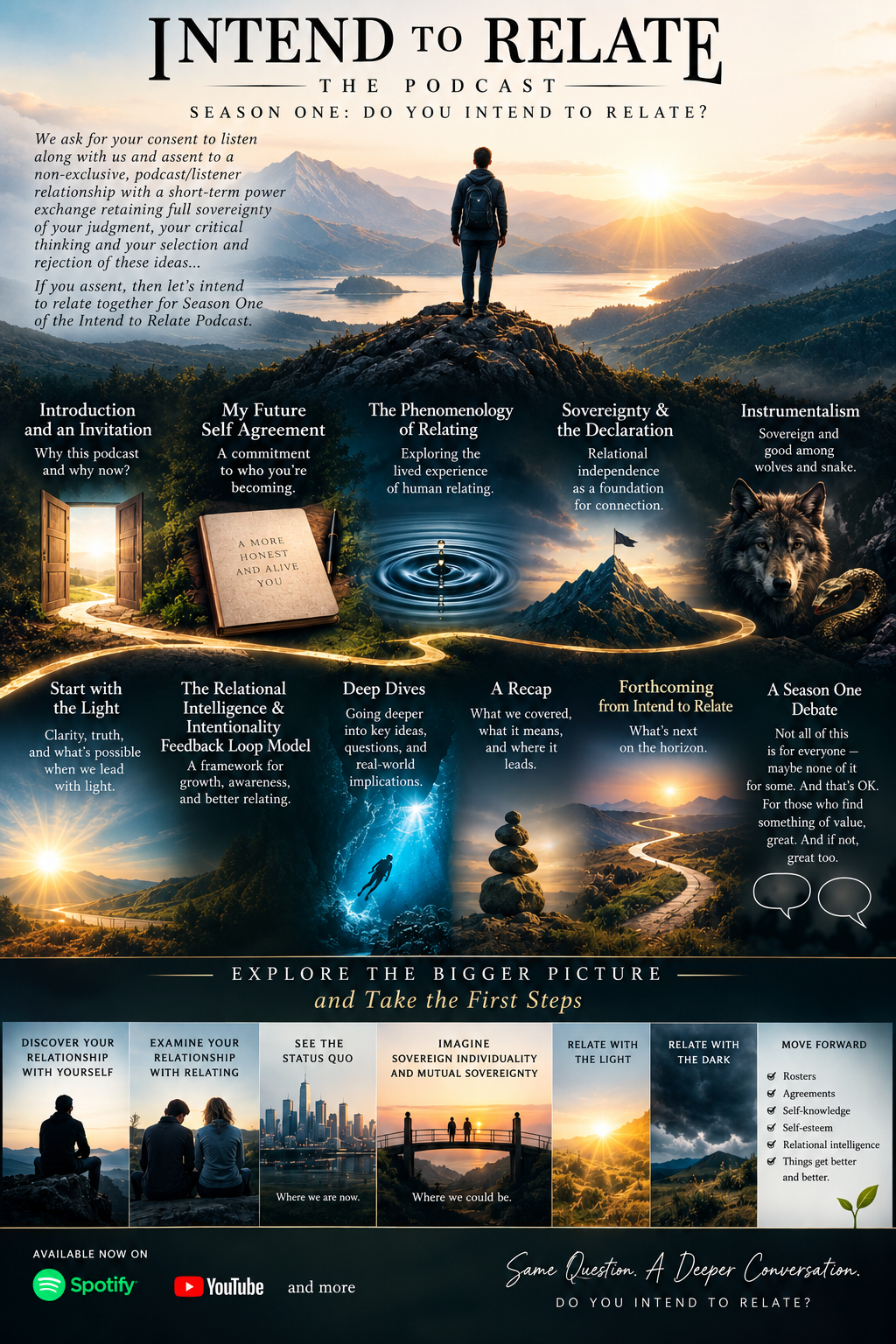
Across the episodes, Intend to Relate develops a vocabulary and toolkit for thinking about relationships: the Future Self Agreement, the Phenomenology of Relating, relational aims and rosters, values and boundaries, ethical instrumentalism, communication, agreement-making, relational intelligence, endings, the shadow, and the ways shared experience can develop into something with its own organization, identity, and meaning.
Some episodes are philosophical. Some are practical. Some tell stories or work through hypothetical relationships. Others follow an idea wherever it leads.
The podcast also serves as a kind of public laboratory for the larger Intend to Relate project. Ideas introduced in one episode may be tested, challenged, refined, or transformed several episodes later. The purpose is not to announce a finished doctrine. It is to develop a way of thinking carefully about how human beings encounter one another and what they might intentionally create together.
Where should I start?
Start at the beginning.
Season One establishes much of the basic vocabulary and orientation of Intend to Relate: beginning with yourself, considering the person you are becoming, examining your intentions, and learning to distinguish what you imagine about another person from what you have actually encountered.
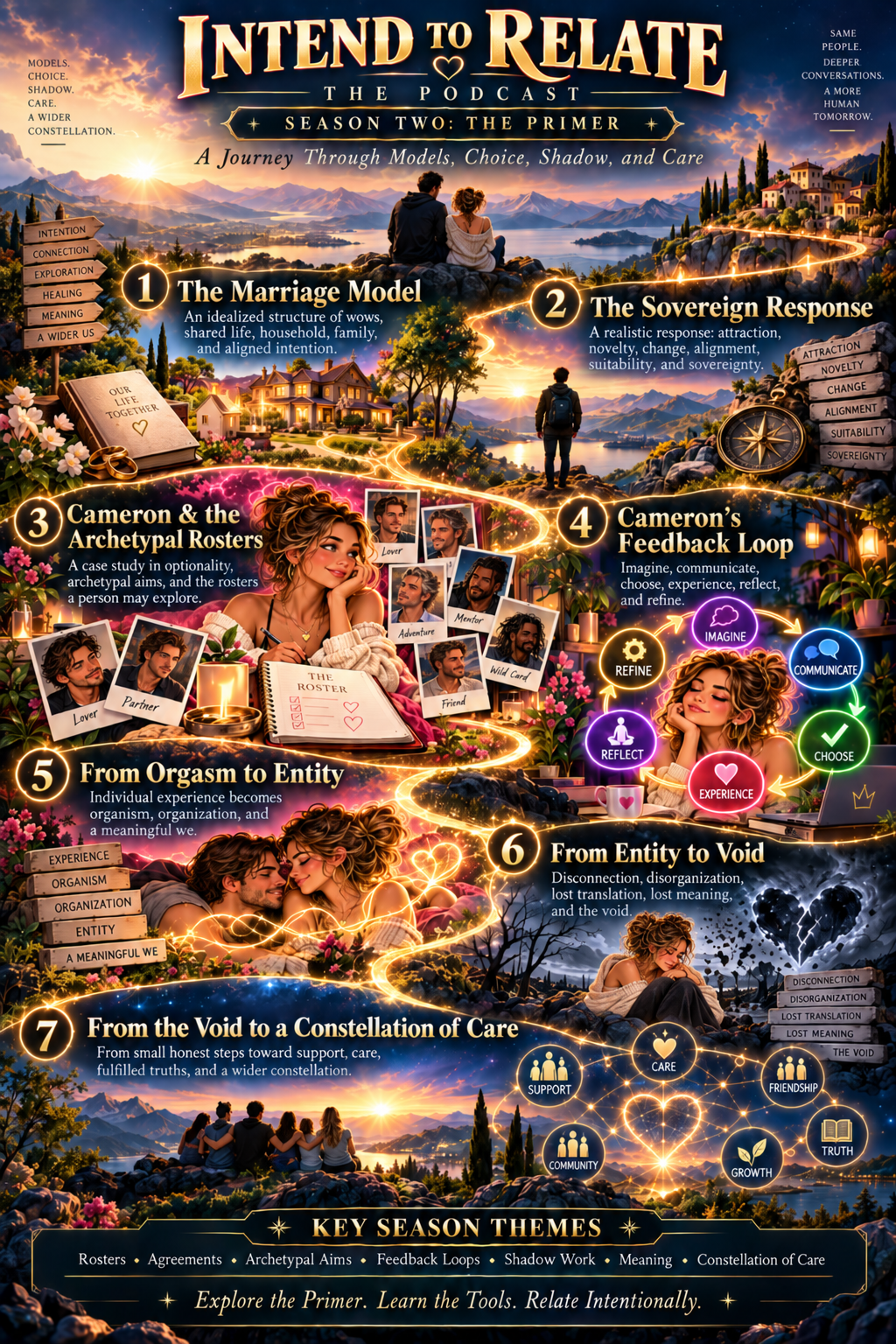
Season Two begins putting those tools to work.
The questions become more concrete and sometimes more playful: What are we actually trying to create? What belongs on our relational rosters? What happens when individual experiences become a shared life—and a shared life becomes organized around a recognizable “we”? What happens when that entity breaks down? And how might the same tools used to design a relationship also help someone find their way through absence, loss, or the void?
The episodes build on one another, so listening sequentially provides the clearest path through the developing framework.
You do not need to agree with every proposition.
In fact, you are invited not to.
The project is an inquiry into intentional relating. Take the concepts seriously enough to test them. Ask what works. Ask what fails. Notice where your own experience produces a different answer.
And then continue the conversation.
Begin with Season One, Episode One, and follow the experiment from there.
Be free, and be good to each other—intentionally.